AI + Human Collaboration: The Future of Business Operations
January 10, 2026
Renshok Engineering Team

A highly pervasive, inherently cynical narrative currently circulating the business world suggests that artificial intelligence will organically and wholesale replace the vast majority of the human workforce. The reality taking definitive shape within the upper echelons of the enterprise sector is fundamentally different and structurally far more powerful: AI is practically never a standalone replacement; it is an unprecedented leverage multiplier.
The organizations currently experiencing explosive, unbridled growth are absolutely not the ones attempting to blindly fire their staff and hand the keys to an autonomous script. They are the companies seamlessly weaving highly scoped AI agents directly into their existing expert human workflows, forging a collaborative intelligence that is vastly greater than the sum of its distinct parts.
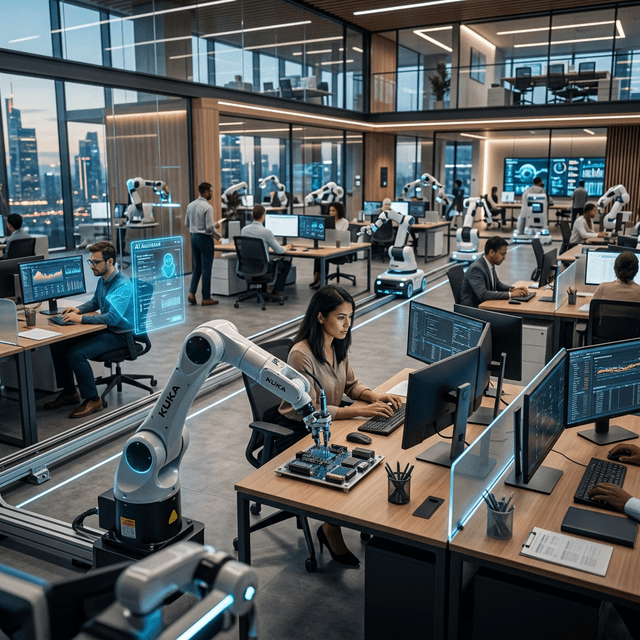
At Renshok, we refer to this specific architectural integration as 'Cognitive Copiloting.' While the underlying AI microservices handle the massive, high-volume data parsing, intricate pattern recognition, and rote API execution, the human operators supply the irreplaceable core elements: strategic empathy, ethical judgment, intense client negotiation, and creative lateral thinking.
Consider the intense daily reality of a senior supply chain manager heavily tracking global freight. Traditionally, they spend up to 70% of their actual working day miserably collating fragmented data across multiple monolithic ERPs just to understand the baseline current state of their shipments. This intentionally leaves only a meager 30% of their cognitive bandwidth for actual, high-value strategic decision-making.
By strategically inserting a custom AI middleware layer into their operational dashboard, the dynamic radically changes. The system preemptively analyzes thousands of live global weather patterns, port congestion telemetry, and historical transit times. The moment a probable disruption occurs, the AI instantly surfaces three highly optimized, financially modeled rerouting options directly onto the manager's screen.
The AI performs the incredibly heavy lifting of data synthesis and probabilistic calculation. The human manager subsequently leverages their deep, nuanced contextual understanding of fragile vendor relationships to make the final, optimal call. The ultimate result? A staggering 5x increase in operational velocity and a massive reduction in executive burnout.
| Operational Element | The Distributed Renshok AI Role | The Human Operator Role |
|---|---|---|
| Data Parsing & Ingestion | Processes 10,000 complex inputs/sec without fatigue | Reviews synthesized, high-level insights |
| Complex Decision Making | Surfaces mathematically optimized tactical paths | Applies strategic empathy & executes the final call |
| Creative Problem Solving | Generates permutations based strictly on past data | Applies lateral thinking to solve entirely novel problems |
| Client Interaction | Drafts highly accurate initial technical responses | Injects brand personality, negotiation, and nuance |
Building software effectively for this collaborative paradigm requires a highly distinct approach to technical architecture. You cannot merely expose a raw command-line terminal to an executive and expect productivity. It heavily demands intuitive, declarative operational UIs—interfaces we almost exclusively build utilizing React and Next.js—that cleanly present complex AI-derived insights without visually overwhelming the human user.
Furthermore, it demands incredibly robust, tightly scoped API gateways that allow the AI to actively take action on the human's behalf only when explicitly authorized. This is the cornerstone of 'Zero-Trust' enterprise architecture. The AI might draft a highly complex refund authorization across three different databases, but the transaction strictly waits in a holding state until the human manager physically clicks 'Approve'.
As we architect these deep systems at Renshok, the primary objective is friction obliteration. The AI should ideally feel invisible to the human operator—acting merely as a hyper-competent, instantaneous extension of their own cognitive process, natively embedded right into the software they already inhabit.
Deep-dive answers into the architecture, security, and integration logic discussed in this briefing.
Partner with Renshok Software Solutions to build exceptional, scalable digital products. Whether you are scaling across India or expanding globally, our expert engineering team is ready to bring your vision to life.