
Custom Software vs SaaS: What Growing Companies Should Choose?

January 7, 2026
Renshok Engineering Team
Custom Software vs SaaS: What Growing Companies Should Choose?

The Mid-Market Enterprise Dilemma

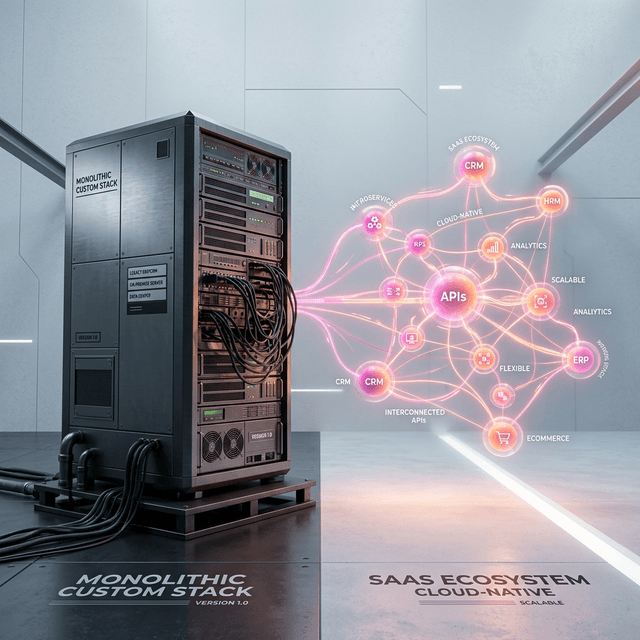
As a mid-market enterprise scales past its initial startup phase, the precarious operational foundation built entirely on chaotic spreadsheets and cheap, generalized Software-as-a-Service (SaaS) subscriptions violently cracks. You eventually end up duct-taping five wildly different cloud platforms together using incredibly fragile API links (like Zapier), resulting in massive, disconnected data silos. At this exact threshold, CTOs and executive boards face a massive architectural fork in the road.

Do we migrate everything to a massive, monolithic enterprise ERP like Salesforce or SAP, accepting the immense licensing costs and painful operational rigidity? Or do we bite the bullet and construct entirely Custom Software engineered specifically for our exact workflows? Both approaches have immense, compounding implications for an organization's internal technical debt, data security perimeter, and ultimate exit valuation.

The Limitations of Generalized Architecture

Generalized SaaS products are mathematically engineered to solve the broadest possible denominator of problems for the largest possible number of companies. They are genuinely excellent for highly standardized, undifferentiated operations like payroll processing, generic HR tracking, or basic SMTP email routing. You should never build your own payroll system. However, because these platforms are built for the masses, their core database schemas actively and aggressively resist deep specialization.

When a SaaS platform attempts to please a thousand different companies simultaneously, its user interface inherently becomes bloated with hundreds of obscure feature toggles your team will never utilize, while paradoxically lacking the single highly specific button your operations team desperately needs to execute their daily workflow effectively.

lightbulb

The Differentiator Destruction Theory

If your company has organically developed a highly proprietary, unique operational workflow that constitutes your actual, defensible competitive advantage, aggressively forcing your team to use a generic off-the-shelf SaaS will explicitly destroy that advantage. You are fundamentally reshaping your agile business logic to fit the generic software, rather than the software fitting your business.
  • Data Lock-in & Schema Inflexibility: You cannot easily alter the core relational SQL tables of a vendor's SaaS. Extracting and analyzing raw data structure out of major SaaS providers is intentionally painful.
  • Per-User License Extortion: Paying massive, compounding monthly per-user licenses for platforms where your team literally utilizes only 10% of the actual features is commercial insanity.
  • Zero Asset Valuation: You are renting an operational tool completely owned by someone else. You build absolutely zero equity in the internal Intellectual Property (IP) of the system.

The Edge of Bespoke Microservices

Custom Software Development, which constitutes the core engineering specialty of Renshok Software Solutions, involves architecting a digital platform entirely from scratch exclusively for your organization's exact logistical needs. We do not use no-code gimmicks. We use the exact same sophisticated technology stack—React, Next.js, Node, Go, PostgreSQL, and AWS Serverless—currently utilized by the Silicon Valley elite.

When you build bespoke infrastructure, the software maps flawlessly 1-to-1 with your internal human processes. Every single API endpoint, every dashboard button, and every database query exists solely because it drives measurable workflow efficiency. There is zero bloat, incredibly fast execution times, and zero compromise.

Furthermore, for aggressively scaling tech or services companies, possessing and outright owning a proprietary digital platform drastically increases the overall Multiplier Valuation of the entire company during acquisition. Investors do not pay premiums for companies relying on fragile third-party SaaS subscriptions; they pay massive premiums for companies owning unyielding proprietary tech moats.

Architectural LimitationThe Generic SaaS RealityRenshok's Custom Software Resolution
Licensing CostsCompounding monthly per-user frictionInfinite Users. Zero monthly license or seat fees.
Database RigidityLocked schema schemas you cannot touchCustom SQL/NoSQL relations tailored strictly to your entities.
Technical SupportReading generalized forums or talking to tier-1 chat botsDirect Slack communication to the Renshok engineering architects.
Infrastructure IsolationShared, multi-tenant databases prone to noisy neighborsDedicated, fully isolated single-tenant AWS/GCP cloud environments.

The Definitive Build vs. Buy Matrix

The golden, unifying rule of senior enterprise architecture is surprisingly elegant: Buy standard commodities; Build core distinct differentiators.

If a specific digital process is exactly the same across every company in your industry—like processing employee tax forms or sending a transactional email—absolutely buy a SaaS tool to handle it. However, if a specific process is the distinct reason your clients choose you over your competitors—whether that is your proprietary supply chain routing, your unique customer onboarding flow, or your novel data analytics algorithm—you must own that technology outright.

At Renshok, we act as the heavily armed engineering division for companies making the transition from renting their infrastructure to owning their future. We build the microservices that generic SaaS platforms literally cannot comprehend.

Technical Architecture FAQ

Deep-dive answers into the architecture, security, and integration logic discussed in this briefing.

Isn't building custom software development prohibitively expensive upfront compared to SaaS?expand_more
While the initial Capital Expenditure (CapEx) is inherently higher than swiping a credit card for a month-to-month SaaS Operational Expense (OpEx), custom software rapidly pays for itself by eliminating compounding per-user license fees. We utilize 'Total Cost of Ownership' models tracking spanning 36 months, which clearly and mathematically demonstrates custom software becoming significantly cheaper upon reaching scaling thresholds.
How do we actually maintain a custom software platform post-launch without an internal IT team?expand_more
Renshok deliberately acts as your dedicated, external DevOps and engineering division post-launch. We establish automated continuous integration pipelines (CI/CD), manage auto-scaling serverless limits directly on AWS, push silent automatic security patches, and monitor application health telemetry globally 24/7/365.
Can entirely custom software natively integrate with the required SaaS tools we still want to keep (like Google Workspace or Stripe)?expand_more
Absolutely, and with significantly more stability than generic Zapier connections. All custom architecture built by Renshok aggressively utilizes API-first methodologies. We build native, secure REST or GraphQL gateways that communicate bi-directionally and flawlessly with Stripe, Slack, Salesforce, Google Workspace, embedded IoT hardware, and virtually any modern platform that exposes an API.
What happens if Renshok disappears? Are we locked out of our own custom software?expand_more
Never. Unlike a SaaS vendor locking your data behind their paywall, Renshok physically hands over the entirety of the uncompiled source code. Furthermore, your custom infrastructure is physically deployed and hosted strictly within your company's own AWS, Vercel, or GCP cloud accounts. You own the root cryptographic keys to the kingdom from day zero.
How long does it realistically take to build a custom enterprise software platform?expand_more
We reject the premise of multi-year 'waterfall' monolithic builds. By utilizing strict agile methodologies and leveraging pre-built foundational components (like our internal authentication and robust UI libraries), Renshok routinely deploys the first highly valuable, polished iteration of a custom platform within 8 to 12 weeks.
Is custom software inherently more secure or less secure than relying on a massive SaaS provider?expand_more
When architected correctly, it is vastly more secure. Massive SaaS providers are high-value targets for global hackers because breaching a single SaaS database compromises thousands of different companies simultaneously. By building a custom, isolated, single-tenant architecture utilizing Zero-Trust principles, your attack surface area is microscopically reduced.
Does building custom software actually increase the exit valuation of the overall business?expand_more
Unequivocally yes. Private equity firms and corporate acquirers perform intense technical due diligence. If your 'tech stack' consists entirely of rented subscriptions managed by fragile scripts, you are valued merely as a conventional services company. If you own a proprietary, highly efficient digital ecosystem that drives your margins, you are valued significantly higher as a scalable technology company.

Ready to Accelerate Your Digital Growth?

Partner with Renshok Software Solutions to build exceptional, scalable digital products. Whether you are scaling across India or expanding globally, our expert engineering team is ready to bring your vision to life.


How AI Is Transforming Small & Mid-Sized Businesses in 2026
AI
January 1, 2026

How AI Is Transforming Small & Mid-Sized Businesses in 2026

How to Automate Your Business Operations Without Hiring More Staff
Automation
January 4, 2026

How to Automate Your Business Operations Without Hiring More Staff

AI + Human Collaboration: The Future of Business Operations
AI
January 10, 2026

AI + Human Collaboration: The Future of Business Operations

call