How Renshok Builds Scalable SaaS Platforms for Modern Enterprises
January 16, 2026
Renshok Engineering Team
Building a functional Software-as-a-Service (SaaS) platform for a localized small business is fundamentally different from architecting an enterprise SaaS specifically engineered to effortlessly serve thousands of distinct corporate clients (tenants) simultaneously. The core challenge resides in constructing a completely unified, singular codebase capable of highly active multi-tenancy while strictly maintaining absolute, mathematically enforced cryptographic isolation of their respective proprietary data.
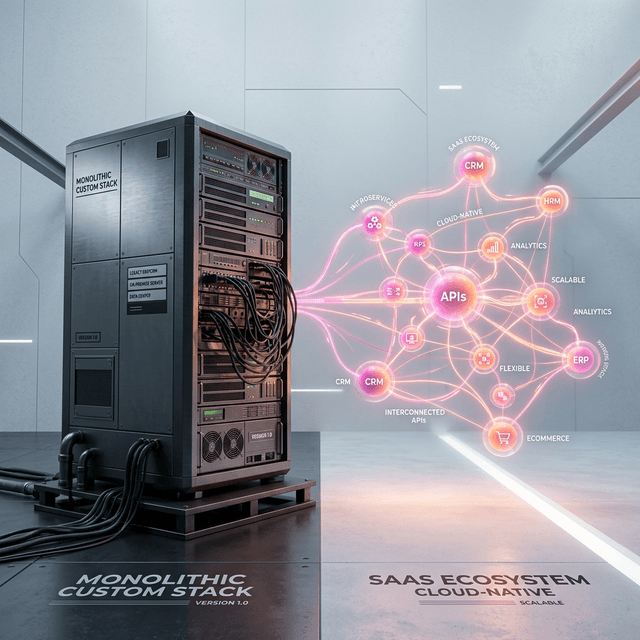
At Renshok, we architect elite SaaS platforms strictly prioritizing three highly explicit core pillars: Infinite API Scalability, Zero-Trust Data Compartmentalization, and Global Sub-100 millisecond Latency. Achieving this ambitious trifecta definitively requires completely bypassing traditional, monolithic LAMP stacks (Linux, Apache, MySQL, PHP) in heavy favor of highly decoupled, entirely serverless, edge-computed architectures utilizing rigorous Node.js and Go microservices.
The absolute most catastrophic, business-ending failure mode for any aspiring multi-tenant SaaS involves 'data bleed'—the horrific scenario where Tenant A accidentally or maliciously queries Tenant B's highly sensitive financial records. To mathematically prevent this from ever occurring, Renshok engineers absolutely do not rely solely on simple, error-prone application-level ORM logic (e.g., arbitrarily appending `WHERE tenant_id = 'xyz'` to raw queries). That approach historically guarantees eventual failure.
Instead, we systematically implement incredibly strict Row-Level Security (RLS) policies residing directly at the core PostgreSQL database kernel level. By utilizing Supabase or configuring highly custom PostgreSQL roles, the database engine itself actively and securely authenticates the decrypted JWT identity token of the incoming request prior to executing the query. If the verified token does not perfectly cryptographically match the specific mathematical row's ownership policies, the database simply pretends the data literally does not exist. It is an impenetrable, zero-trust layer of robust defense.
| Data Isolation Layer | Traditional Monolith App | Renshok SaaS Architecture |
|---|---|---|
| Query Filtering | Prone to junior developer ORM logic errors | Strictly Enforced at the Database Kernel (RLS) |
| Schema Structure | Massive, impossible to manage duplicated databases | Unified shared schema, logical perfect isolation |
| Identity Verification | Easily manipulated legacy Session Cookies | Edge-validated cryptographic JWT Auth tokens |
| Data Boundary Defense | Basic Web Application Firewalls (WAF) | Comprehensive Zero-Trust internal network meshes |
Ingress traffic heavily hitting enterprise SaaS platforms is inherently entirely erratic. A massive global client electing to run a colossal end-of-month financial reconciliation report can spontaneously spike pure compute demand by 5,000% within seconds. Traditional, manually provisioned physical servers would either instantly crash under the immense load or require the company to burn massive capital continually paying for wildly expensive over-provisioning 'just in case'.
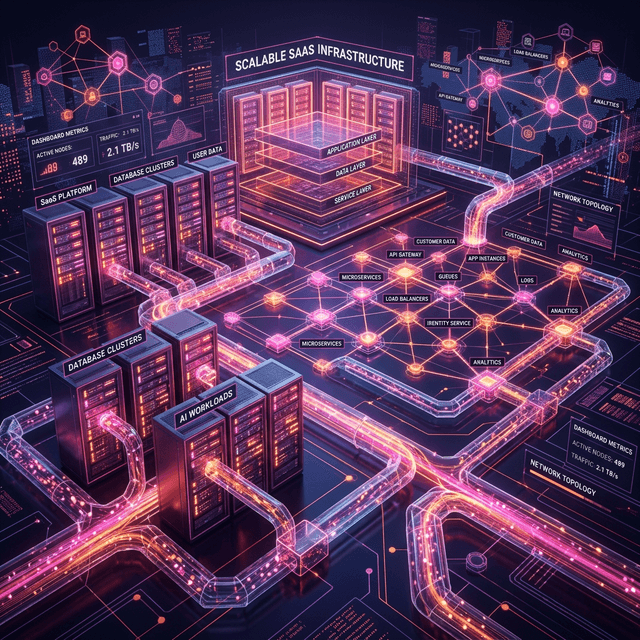
Renshok cloud architectures completely circumvent this archaic problem by aggressively utilizing managed serverless containerization grids (such as optimized AWS Fargate deployments or specialized Vercel Edge Networks). The underlying compute infrastructure automatically and virtually instantaneously spins up thousands of heavily concurrent 'micro-instances' specifically to actively process the massive load parallelization, and subsequently spins them immediately down to absolute zero the millisecond the specific workflow completes. You mathematically only pay for the precise compute cycles successfully utilized.
Furthermore, for inherently asynchronous, intensely heavy computational workloads (such as generating massive, intricate 500-page PDF reports or processing deep Machine Learning AI vector embeddings), we strictly utilize incredibly robust, decoupled event streaming platforms like managed Apache Kafka clusters or AWS Simple Queue Service (SQS).
By rigorously decoupling the interface from the backend processing, the frontend React dashboard is absolutely never blocked while waiting for a heavy backend process to lazily finish; complex application state is managed cleanly and securely via high-speed, distributed Redis cache layers and instantaneous real-time WebSockets. This architectural design explicitly creates the 'instantaneous' feeling that highly demanding enterprise users strongly expect.
Deep-dive answers into the architecture, security, and integration logic discussed in this briefing.
Partner with Renshok Software Solutions to build exceptional, scalable digital products. Whether you are scaling across India or expanding globally, our expert engineering team is ready to bring your vision to life.